

Sectoral Discussion on CEPA Monitoring in Yerevan: Turning Challenges into Opportunities
Hours and dates
Purpose of the Event: Civil Society Perspective on the Implementation of the Comprehensive and Enhanced Partnership Agreement (CEPA): Turning Challenges into Opportunities
Format of the Event: Presentations and discussions based on the findings of the independent civil society monitoring of CEPA implementation
Organizer: “Support to CEPA Monitoring, Implementation and Communication” Project (hereinafter referred to as the Project)
Date: 18 February 2026
Venue: Armenia Marriott Hotel, Tigran the Great Hall, Yerevan
Participants: More than 80 representatives of state institutions, civil society organizations, international organizations and the expert community
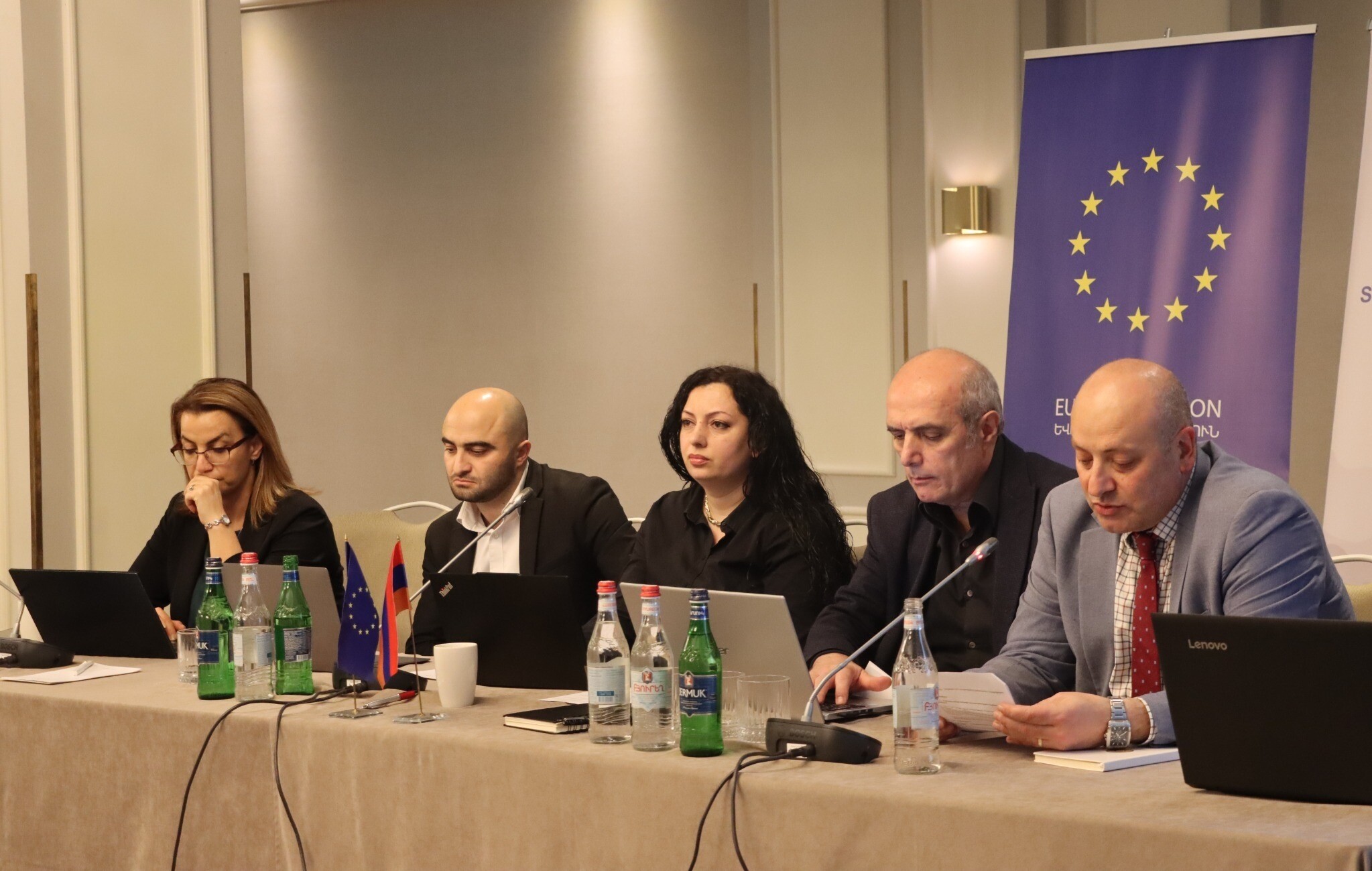
On 18 February 2026, a one-day discussion was held on the results of the monitoring of CEPA implementation. The monitoring exercise was conducted during 2024–2025 by independent civil society experts using a common methodology developed by the Project team. Effective implementation of CEPA requires not only independent civil society monitoring, but also constructive, open and objective discussions of the findings.
The purpose of the public discussion was to bring together representatives of relevant line ministries and other public institutions, as well as representatives of civil society organizations and the expert community, to engage in a high-level professional exchange aimed at identifying and advancing new approaches and practical solutions for the effective implementation of CEPA.
The event consisted of five thematic sessions developed in cooperation with the relevant ministries. During these sessions, experts presented the findings of their monitoring activities, recommendations, and proposed follow-up actions under CEPA. The presentations were followed by moderated discussions involving representatives of line ministries, public institutions, sectoral civil society organizations, and independent experts.
The full set of presentations, assessments and recommendations is available in the CEPA monitoring reports and related documents published in Armenian and English on www.cepacso.am. Responsibility for the content of the published monitoring reports and presentations lies solely with the authors and does not necessarily reflect the views of the European Union.

A brief overview of the issues presented and discussed during the thematic sessions is provided below.
1. Reforms in the Fields of General Education, Higher and Non-Formal Education, as well as Youth Workers
The session covered the actions envisaged under CEPA in the areas of general education, higher education, non-formal education and the training of youth workers. Experts presented assessments of the implementation of these commitments, recommendations for future action, and proposals regarding new Key Performance Indicators (KPIs).
2. Reforms in Public Health and Mental Health
During this session, experts presented analyses of the implementation of healthcare-related provisions under CEPA and shared the findings of the monitoring of mental health legislation and policy frameworks.
3. Justice and Human Rights Reforms
The discussion focused on CEPA-related commitments in the areas of justice and human rights, including challenges related to ensuring the right to a public hearing within a reasonable time and ongoing reforms in criminal justice and human rights.
4. Reforms in Labour Rights, Social Security Protection and Social Inclusion
Independent experts analysed the obligations related to the protection of the rights of persons with disabilities and reviewed the achievements, challenges and remaining gaps in the reform of the Labour Inspectorate under CEPA, together with possible ways forward.
5. Reforms in the Areas of Environmental Governance, Climate Change, Energy and Balanced Development
During this session, issues related to environmental governance were presented and discussed, including the implementation of CEPA commitments in the areas of Environmental Impact Assessment and Strategic Environmental Assessment. Policies aimed at climate change mitigation and adaptation, as well as their implementation under CEPA, were analysed. The discussion also addressed the implementation of actions aimed at enforcing the energy efficiency provisions under CEPA and the results achieved. Particular attention was given to challenges related to the implementation of the balanced development provisions set out in CEPA.
General Observations and Summary of Discussions
-
All experts raised identical concerns related to the new CEPA Roadmap, both regarding the way it was adopted and around the unclear and generic content, plus the absence of measurable KPIs (Key Performance Indicators) in most sections. The CEPA Roadmap was adopted without due consultations with the expert community, civil society or any other stakeholder as some key stakeholders were unaware of the fact that the Roadmap was already adopted.
-
All experts encouraged the Government to be more open, constructive and inclusive in its engagement with civil society, and the manner in which the CEPA Roadmap was adopted was considered a missed opportunity.
-
The new CEPA Roadmap, despite having a separate section on KPIs, does not provide measurable KPIs for the majority of thematic areas.
-
The civil society considers the newly adopted CEPA Roadmap as a dynamic document that still may change and remain under continuous monitoring, evaluation, and revision in line with evolving needs.
-
The overdue and completed activities should be removed from the new CEPA Roadmap and also those EU regulations and directives that are no longer in force should be removed or replaced by the new EU acquis in force, covering the respective issues.
-
Both the civil society representatives and the government officials underlined the importance of the dialogue and asked for further discussion on each topic separately in a format of workshop with clear takeaways and action points.
